Ethereum — a decentralized blockchain platform for launching smart contracts and decentralized applications (dApps). Unlike Bitcoin, which was created as digital currency, Ethereum was conceived as a “world computer” for programmable financial operations.
Why this matters:
Ethereum enabled the creation of not just cryptocurrencies, but entire financial applications without intermediaries: lending, staking, token swaps, NFTs, and much more.
What Is Ethereum in Simple Terms
Ethereum — a blockchain with programmable logic. If Bitcoin is “digital gold” (store of value), then Ethereum is “digital oil” (fuel for applications).
Real-life example:
Bitcoin is like a calculator (one function: transfers). Ethereum is like a smartphone (many functions: lending, swaps, games, collectible tokens).
Key difference:
- Bitcoin: BTC transfer from A to B
- Ethereum: Code execution on blockchain (smart contracts)
Ethereum History: From Idea to ETH 2.0
2013-2014: Idea and Launch
2013: Vitalik Buterin (19 years old, Russian-Canadian programmer) publishes Ethereum Whitepaper.
Idea: Bitcoin is too limited. We need a blockchain with programmable logic.
2014: Ethereum crowdfunding.
- Token price: $0.31
- Raised: $18 million in BTC
- Sold: 60 million ETH
2015: Main network launch (July 30, 2015).
2016-2020: Growth and Problems
2016: The DAO — decentralized investment fund.
- Raised $150 million
- Hack due to code vulnerability
- Controversial decision: transaction rollback (hard fork)
- Result: split into Ethereum (ETH) and Ethereum Classic (ETC)
2017: ICO boom (Initial Coin Offering).
- 90% of ICOs launched on Ethereum
- ETH price: $8 (start of year) → $1,400 (end of year)
- Problem: network congestion, high fees
2020: DeFi Summer (decentralized finance).
- Launched: Uniswap, Aave, Compound, MakerDAO
- TVL (Total Value Locked): $1 billion → $15 billion
- Problem: fees up to $50-100 per transaction
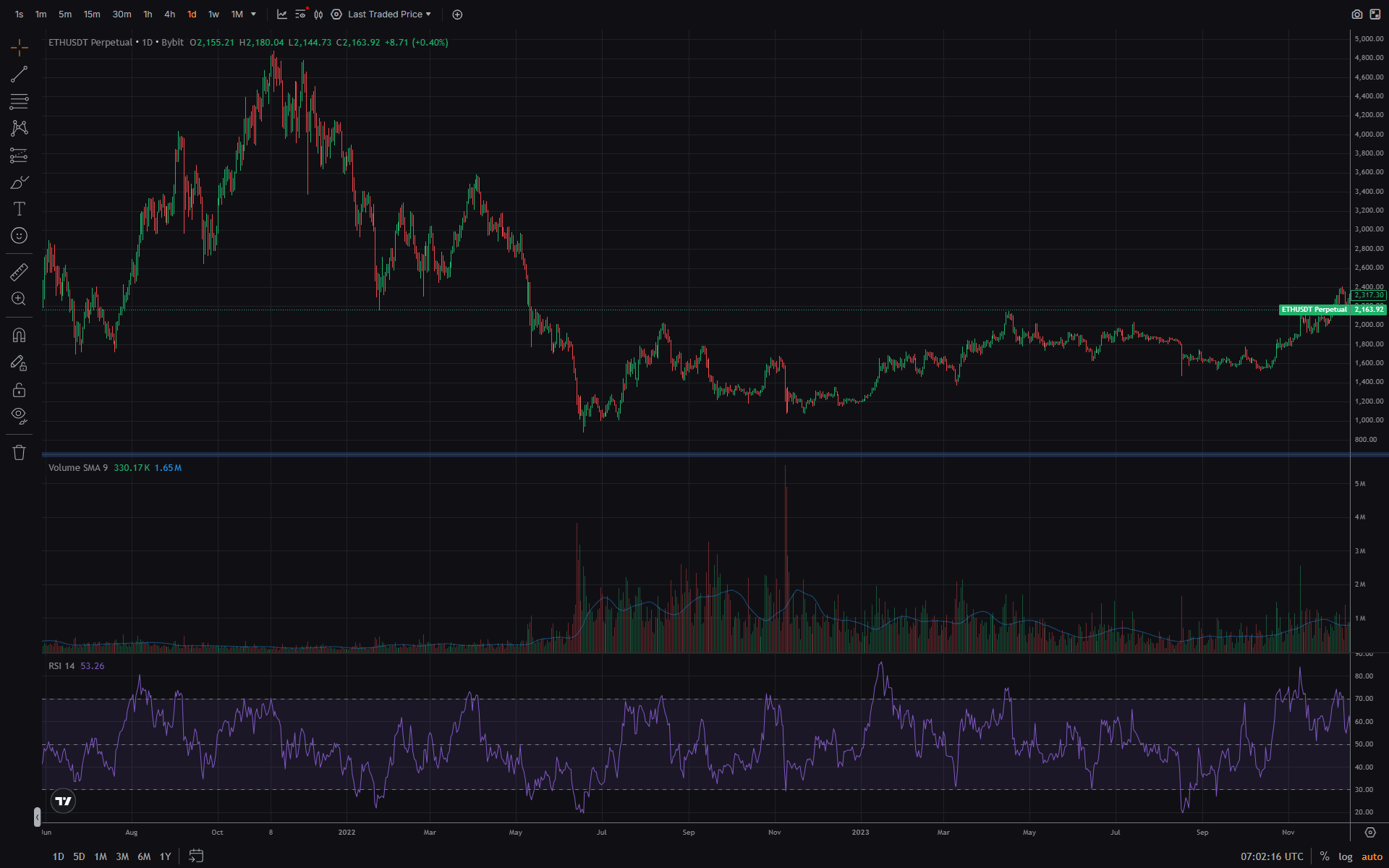
2022: The Merge — Transition to Proof-of-Stake
September 15, 2022: Ethereum transitioned from Proof-of-Work to Proof-of-Stake.
What changed:
- Energy consumption: -99.95%
- GPU mining: discontinued
- ETH staking: became available to everyone
- ETH inflation: became deflationary (fee burning)
What didn’t change:
- Fees: remained high (solution — Layer 2)
- Speed: ~15 transactions per second (solution — sharding in the future)
How Ethereum Works
Blockchain and Transactions
Ethereum blockchain — a distributed ledger that stores:
- Address balances (ETH)
- Smart contract code
- Contract data (state)
Transaction — an action on the network:
- ETH transfer
- Smart contract call
- Contract deployment
Block time: ~12 seconds Throughput: ~15 TPS (transactions per second)
Smart Contracts
Smart contract — a program on the blockchain that executes automatically when conditions are met.
Example:
Decentralized exchange (DEX):
- User A wants to swap 1 ETH for USDC
- User B wants to swap 2000 USDC for ETH
- Smart contract automatically executes the swap
- No intermediary, no KYC
Advantages:
- Automatic execution (no need to trust a person)
- Transparency (code is open)
- Censorship resistance (no one can shut it down)
Disadvantages:
- Code bugs = loss of funds (irreversible)
- Fees for every action
- Difficulty upgrading (contract cannot be modified)
Gas (Gas) — Network Fee
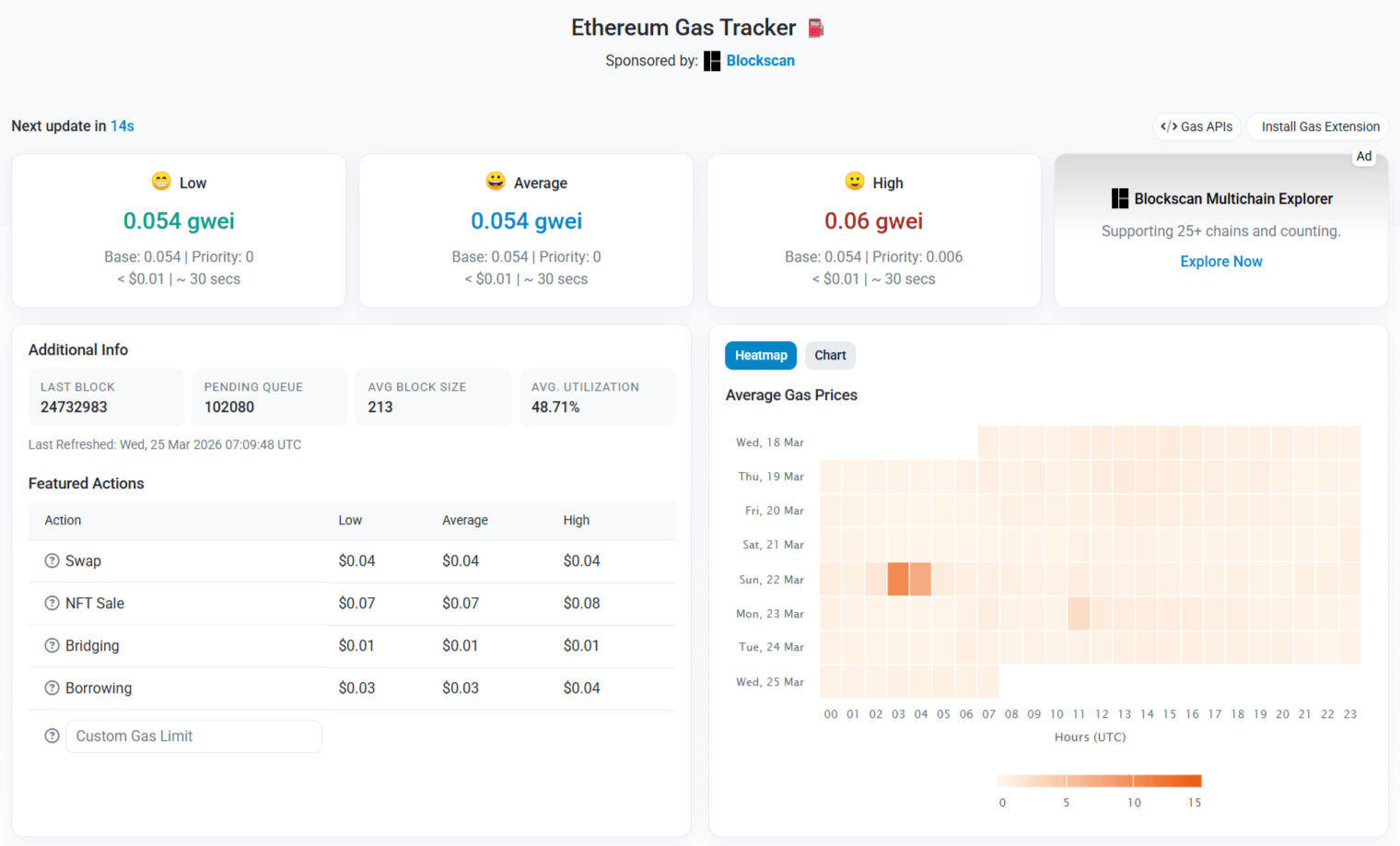
Gas — a unit of computational work measurement in Ethereum.
Why gas is needed:
- Spam protection (every operation costs money)
- Payment to miners/validators
- Limiting computational complexity
How fee is calculated:
Fee = Gas Used × Gas PriceExample:
- ETH transfer: 21,000 gas
- Complex contract: 100,000-500,000 gas
- Gas Price: 20 gwei (0.00000002 ETH)
- Fee: 21,000 × 20 gwei = 0.00042 ETH (~$1-5 in calm times, $50-100 at peak)
Gwei — a unit of gas price measurement (1 gwei = 0.000000001 ETH).
ETH — Ethereum Token
Tokenomics ETH
Token type: Utility + Governance
ETH functions:
- Gas payment — all transactions are paid in ETH
- Staking — collateral for validators (32 ETH for own node)
- DeFi collateral — security for loans, liquidity in pools
- Store of value — “digital oil” + deflationary model
Emission:
- Before The Merge: ~4.5% annually (mining + staking)
- After The Merge: ~0.5% annually (staking only)
- Burning: Base fee is burned (EIP-1559)
- Net inflation: Can be negative (deflation) with high activity
Distribution:
- ~83 million ETH in circulation (March 2026)
- ~28 million ETH staked (33% of supply)
- No hard cap (unlike BTC 21 million)
Comparison: ETH vs BTC
| Parameter | Bitcoin (BTC) | Ethereum (ETH) |
|---|---|---|
| Goal | Digital gold | World computer |
| Emission | 21 million (hard cap) | Unlimited (deflationary model) |
| Block | 10 minutes | 12 seconds |
| TPS | ~7 | ~15 |
| Consensus | Proof-of-Work | Proof-of-Stake |
| Staking | No | Yes (3-5% annually) |
| Burning | No | Yes (EIP-1559) |
Ethereum Staking
What Is Staking
Staking — locking ETH to support network operations and earning rewards.
How it works:
- Validator locks 32 ETH (or less through pools)
- Validator verifies transactions and creates blocks
- Validator earns rewards (~3-5% annually)
- For violations (downtime, malicious behavior) — penalty (slashing)
Staking Methods
| Method | Min. Amount | Flexibility | Risk | Yield |
|---|---|---|---|---|
| Own node | 32 ETH | 28 days to withdraw | Low | 3-5% |
| Pools (Lido, Rocket Pool) | 0.01 ETH | Flexible (stETH, rETH) | Medium | 3-4% |
| Exchanges (Bybit, Binance) | 0.0001 ETH | Depends on exchange | Medium | 2-4% |
Popular solutions:
- Lido (stETH): Largest pool, liquid token
- Rocket Pool (rETH): Decentralized, lower fees
- Bybit/Binance: Simple, but custodial risk
Ethereum Ecosystem
DeFi (Decentralized Finance)
DeFi — financial applications without intermediaries.
Categories:
- DEX (decentralized exchanges): Uniswap, SushiSwap, Curve
- Lending: Aave, Compound, MakerDAO
- Staking: Lido, Rocket Pool, Ankr
- Derivatives: dYdX, GMX, Synthetix
TVL (Total Value Locked): $50-100 billion (fluctuates)
NFT (Non-Fungible Tokens)
NFT — unique tokens for digital art, collectibles, gaming items.
Popular standards:
- ERC-721: Unique tokens (CryptoPunks, Bored Apes)
- ERC-1155: Semi-fungible tokens (games, collections)
Marketplaces: OpenSea, Blur, LooksRare
Layer 2 (Second Layer Solutions)
Layer 2 — Ethereum overlays for reducing fees and increasing speed.
Why Layer 2 is needed:
- Ethereum: ~15 TPS, fees $1-50
- Layer 2: ~100-4,000 TPS, fees $0.01-0.10
Layer 2 types:
Optimistic Rollups:
- Arbitrum: Largest by TVL ($3-5 billion)
- Optimism: Backed by Coinbase (Base built on OP)
- Base: Coinbase exchange, rapid growth
- Mechanics: Transactions executed off Ethereum, results published on mainnet
ZK-Rollups:
- zkSync Era: ZK-proofs, fast
- Starknet: Cairo language, high performance
- Polygon zkEVM: Ethereum compatibility
- Mechanics: ZK-proofs of transaction validity
Layer 2 Solutions Comparison
| Solution | Type | TVL (billions $) | Fees | Withdrawal to Mainnet |
|---|---|---|---|---|
| Arbitrum | Optimistic | 3-5 | $0.01-0.10 | 7 days |
| Optimism | Optimistic | 1-2 | $0.01-0.10 | 7 days |
| Base | Optimistic | 1-2 | $0.01-0.10 | 7 days |
| zkSync Era | ZK | 0.5-1 | $0.01-0.05 | Instant |
| Starknet | ZK | 0.3-0.5 | $0.01-0.05 | Instant |
| Polygon zkEVM | ZK | 0.1-0.3 | $0.01-0.05 | Instant |
How to start using Layer 2:
- Buy ETH on exchange
- Bridge to L2 via Arbitrum Bridge, Optimism Gateway
- Use in DeFi (Uniswap, Aave on L2)
- Fees: $0.01-0.10 per swap
Advantages:
- Low fees ($0.01-0.10 vs $1-50)
- High speed (~100-4,000 TPS)
- Ethereum compatibility (same addresses, keys)
Disadvantages:
- Need to use bridge (additional step)
- Some protocols not yet ported
- Withdrawal to mainnet can take 7 days (Optimistic)
Recommendation: For small amounts (< $1,000) use Layer 2. For large amounts — Ethereum mainnet.

Ethereum Risks
1. Competition
Problem: Solana, Cardano, Avalanche offer higher speed and lower fees.
Ethereum’s response: Layer 2, sharding, continuous upgrades.
2. Regulatory Risks
Problem: SEC may classify ETH as a security.
Status: ETH is currently considered a commodity (like BTC), but the question remains open.
3. Technical Risks
Problem: Smart contract bugs, bridge vulnerabilities.
Examples:
- The DAO (2016): $60 million stolen
- Wormhole (2022): $320 million stolen from Solana-Ethereum bridge
How to protect yourself:
- Use audited contracts
- Don’t keep everything in one protocol
- Diversify risks
How to Buy and Store ETH
Buying ETH
Methods:
- Crypto exchanges: Bybit, Binance, Coinbase (simple, but custodial)
- DEX: Uniswap, 1inch (decentralized, but need ETH for gas)
- P2P: LocalCryptos, Bisq (direct from person)
- Crypto ATMs: BitAccess, General Bytes (cash → ETH)
Recommendation: For beginners — exchange (Bybit, Binance). For large amounts — P2P or DEX.
Storing ETH
| Type | Examples | Security | Convenience | Fees |
|---|---|---|---|---|
| Hardware wallet | Ledger, Trezor | ⭐⭐⭐⭐⭐ | ⭐⭐⭐ | $50-150 (one-time) |
| Software wallet | MetaMask, Trust Wallet | ⭐⭐⭐⭐ | ⭐⭐⭐⭐ | Free |
| Exchange | Bybit, Binance | ⭐⭐ | ⭐⭐⭐⭐⭐ | Free (but withdrawal fees) |
| Paper | Seed phrase printout | ⭐⭐⭐ | ⭐ | Free |
Recommendation:
- Up to $1,000: exchange (simple)
- $1,000-10,000: software wallet (MetaMask)
- From $10,000: hardware wallet (Ledger Nano X)
Security: Checklist
- Seed phrase: write on paper, store in safe
- 2FA: Google Authenticator (not SMS!)
- Address verification: first and last 4 characters
- Test transaction: before large amount
- Don’t store more than 10% of capital on exchange
- Don’t click links from emails (phishing)
- Don’t give wallet access to third parties
2026-2030 Forecasts: Possible Scenarios
Ecosystem Development
Expected trends:
- Layer 2 will become mainstream for users
- Sharding will increase throughput
- Institutional adoption (ETH ETFs already approved)
Price Impact: Scenarios
Bull scenario (optimistic):
- Mass adoption of DeFi and NFT
- Deflationary model (burning > emission)
- ETH price: $10,000-20,000
Bear scenario (pessimistic):
- Competition from Solana, Cardano
- Regulatory problems
- ETH price: $1,000-2,000
Important: These are analyst forecasts, not financial advice. Past performance does not guarantee future results.
Summary
Ethereum — a smart contract and dApp platform. ETH is used for gas payments, staking, and as a store of value.
Key rules:
- Understand the difference between ETH and ERC-20 tokens
- Use Layer 2 for low fees
- Store ETH in a secure wallet (not on exchange)
- Stake ETH for passive income (3-5% annually)
Who Ethereum is for:
- dApp developers
- DeFi and NFT users
- Long-term investors
- Stakers
Who it’s NOT for:
- Payments only (BTC is better)
- Don’t trust smart contracts
- Want 100% anonymity
FAQ
How much ETH is in circulation?
~83 million ETH (March 2026). No hard cap, but emission is low (~0.5% annually).
Can you mine Ethereum?
No. After The Merge (September 2022), Ethereum transitioned to Proof-of-Stake. Mining is impossible.
What is stETH?
stETH — liquid staking token from Lido. You receive stETH for locked ETH and can use it in DeFi.
Is it safe to stake ETH on an exchange?
Depends on the exchange. Bybit, Binance — reliable, but custodial risk remains. For large amounts — own node or decentralized pools (Lido, Rocket Pool).
Why are fees so high?
Ethereum is congested (many users). Solution — Layer 2 (Arbitrum, Optimism, Base), where fees are $0.01-0.10.
What is EIP-1559?
Ethereum upgrade (August 2021). Base fee is burned, making ETH deflationary during high activity.
Disclaimer
This blog is for informational purposes only. It does not constitute financial or investment advice.
Trading cryptocurrencies and other financial instruments involves high risk. You may lose all your funds.
The author is not responsible for any financial losses resulting from the use of information from this blog.