Fundamental analysis helps you see whether an asset is worth your attention and whether the market is overheated. In crypto there are no IFRS reports, but there are on-chain metrics, tokenomics, and macro. This article covers how FA in crypto differs from the classic approach and how to combine it with technical analysis.
Why fundamentals matter for traders
Most traders start with candles, levels, and indicators. Fundamentals feel “long and complicated,” so they often get postponed. Without them, the decision to enter or not relies mainly on the chart: trend up — we enter, no trend — we wait. But the same chart can be the start of a strong move or a trap before a crash. Fundamental analysis does not give you the exact entry point, but it helps filter junk and understand context: are we closer to overheated or to a zone where the asset has historically bounced?
It makes sense to use FA as a filter: first “is this asset worth looking at at all,” then technical analysis for the entry point. For a 15-minute check, see the fundamental analysis checklist.
What is fundamental analysis in the classic sense
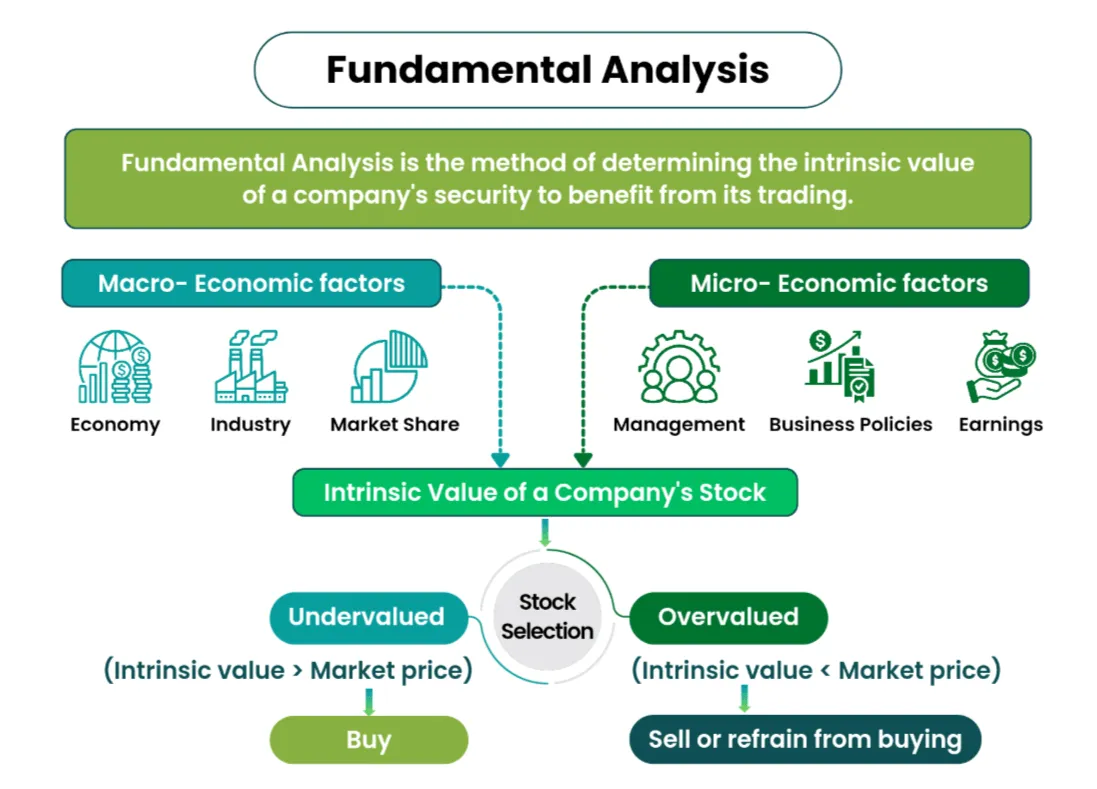
In traditional finance, fundamental analysis is the assessment of an asset by its “intrinsic” value, not just the price on the chart.
For stocks you look at the business: revenue, profit, debt, multiples (e.g. P/E — price per share to earnings per share), dividends, market share. The question: “How much does the company earn and does the stock price reflect that?”
For currencies you look at the economy of the country or zone: central bank rates, inflation, trade balance, unemployment. The question: “Is the currency strong from an economic standpoint?”
In both cases FA answers “what to buy or hold” and “are we overpaying,” not “where to place the order.” The entry point comes from technical analysis.
How crypto fundamentals differ
In crypto there is no IFRS-style reporting and no central bank. There is no single project “balance sheet” in the classic sense. So the data set is different.
What you have instead:
- Technology and network architecture — how the blockchain works, speed, fees, security.
- On-chain metrics — data from the chain itself: MVRV, NVT, exchange reserves, coin flows. They show how participants behave “inside” the network. For more, see the article on on-chain metrics in fundamental analysis.
- Tokenomics — emission, supply cap, vesting, unlock schedule. The question: will a mass unlock dump the price?
- Team, community, regulation — who stands behind the project, is there a live product and community, how is the regulatory backdrop changing.
In short: in stocks fundamentals are “business and money,” in crypto they are “network, incentives, and blockchain data.” The goal is the same — to see if the asset is overheated and whether it has a basis for long-term interest.
Fundamental and technical analysis: how they work together
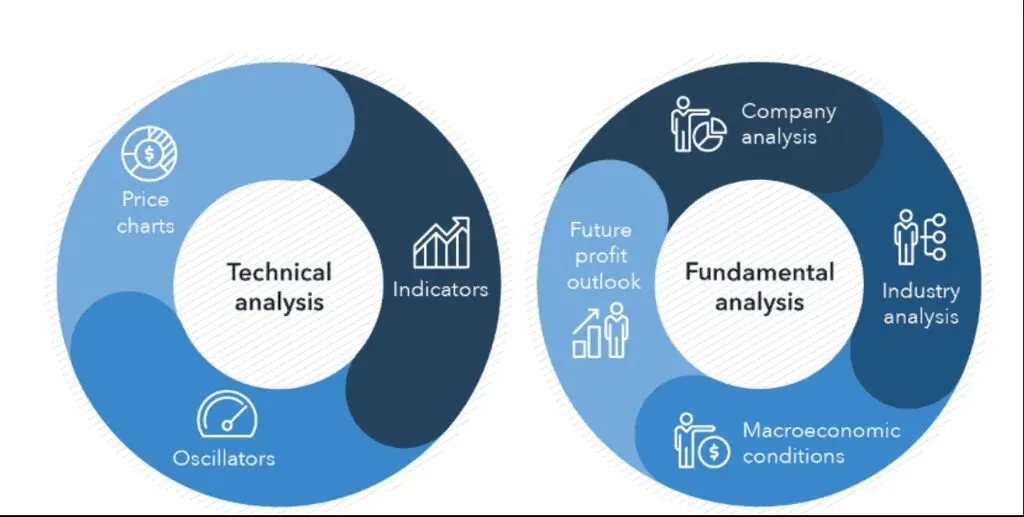
FA and TA answer different questions. It makes sense to use them in sequence.
Fundamentals answer: “Is this asset worth attention at all?” “Are we closer to overheated or to undervaluation/capitulation?” “Are there structural risks (tokenomics, regulation)?”
Technical analysis answers: “Where exactly to enter and exit in the next days or weeks?” “What levels and indicators confirm the scenario?”
Practical example: on-chain and tokenomics show the asset is not overheated and large wallets are accumulating. Then you look for long setups on the chart — levels, indicators, volume. Conversely, if FA points to overheating or mass unlocks, it’s wiser not to add to longs and to look for take-profit or short setups.
Decision Matrix:
| FA | TA | Decision |
|---|---|---|
| ✅ Strong | ✅ Signal | Enter with full position |
| ✅ Strong | ❌ No signal | Wait, asset in portfolio |
| ❌ Weak | ✅ Signal | Skip or short trade |
| ❌ Weak | ❌ No signal | Ignore asset |
Framework: three steps for a trader
You can split the fundamental check into three blocks. You don’t have to go deep in all at once — start with one and expand.
Step 1. Macro and narrative
Central bank rates, crypto regulation, main market “stories” (halving, ETF, sanctions, etc.). This is the context in which the whole market and individual coins move.
What to watch:
- Fed rate (interest rates in the US)
- Inflation (CPI, PCE)
- Regulatory news (SEC, crypto laws)
- Narratives (halving, ETF, DeFi, NFT, AI)
Step 2. Asset quality
Top coins with liquidity and history vs little-known tokens; technology, tokenomics, team and product. The goal is to filter out what isn’t worth looking at on the chart.
Checklist:
- Top 100 by market cap (CoinMarketCap, CoinGecko)
- Working product (website, documentation, GitHub)
- Active community (Twitter, Discord, Telegram)
- Transparent tokenomics (whitepaper, unlock schedule)
Step 3. On-chain cycle context
MVRV, exchange reserves, network activity. Helps see which phase of the cycle we’re in: accumulation, growth, distribution, or capitulation.
Key metrics:
- MVRV < 1 — undervaluation zone
- Outflow from exchanges — accumulation
- SOPR < 1 — capitulation
- Whale activity — growing interest
For a detailed look at on-chain metrics, see the dedicated article; for a quick token run-through, see the 15-minute checklist.
Limitations of fundamental analysis
FA is a powerful tool but not perfect.
Limitations:
- Doesn’t give precise entry and exit points
- Takes time to learn (30-60 minutes per asset)
- Data can be incomplete or outdated
- In crypto, high volatility overrides fundamentals on short timeframes
How to reduce risks:
- Combine FA with TA and risk management
- Use checklists to speed up analysis
- Keep up with updates (tokenomics, regulation)
- Don’t rely on a single data source
Summary
Fundamental analysis does not replace technical analysis; it complements it: it helps select assets and understand cycle context. A trader who uses both FA and TA is better at telling “pump for the sake of pump” from a trend with a basis and relies less on the chart alone.
Key takeaways:
- FA answers “what to buy,” TA answers “when to enter”
- In crypto, use on-chain metrics, tokenomics, team
- Framework: macro → asset quality → on-chain context
- Combine FA with TA and risk management
For more on tokenomics, see What Is Tokenomics.
FAQ
What is fundamental analysis in simple terms?
Assessing an asset by “intrinsic” data: for stocks — business and profit, for currencies — the economy, for crypto — technology, tokenomics, and blockchain data. The question: “Is this asset worth the money and is the market overheated?”
How does FA in crypto differ from FA in stocks?
In crypto there are no IFRS reports. Instead you use on-chain metrics (MVRV, exchange reserves, coin flows), tokenomics (emission, unlocks), and assessment of technology and team. The goal is the same — to understand value and risks.
How to combine fundamental and technical analysis?
First FA: “Is this asset worth looking at, is it overheated?” Then TA: “Where to enter and exit” by levels and indicators. FA sets context and filter, TA sets entry and exit points.
Why do traders need on-chain metrics?
They show how participants behave in the network (accumulation, selling, exchange reserves) and the phase of the cycle. They complement the chart: the chart says “how” price moves, on-chain says “why” and “how sustainable it is.”
How long does fundamental analysis take?
Initial assessment: 15-30 minutes (checklist). Deep analysis: 1-2 hours (tokenomics, team, competitors, on-chain). For regular assets, updating data once a week or before major events is enough.
What services to use for fundamental analysis?
- On-chain: Glassnode, CryptoQuant, Nansen
- Tokenomics: Token Unlocks, Token Terminal
- Aggregators: CoinMarketCap, CoinGecko
- News: Twitter, Discord, Telegram of projects
Can you trade only by fundamentals?
No. FA doesn’t give precise entry points. Even with strong fundamentals, an asset can fall for weeks or months. Use TA for entry and stop losses to protect capital.
Disclaimer
This blog is for informational purposes only. It does not constitute financial or investment advice.
Trading cryptocurrencies and other financial instruments involves high risk. You may lose all your funds.
The author is not responsible for any financial losses resulting from the use of information from this blog.