Solana — a high-performance blockchain for decentralized applications (dApps) with throughput up to 65,000 transactions per second and fees ~$0.00025. Unlike Ethereum, Solana uses a unique Proof-of-History (PoH) consensus mechanism to achieve high speed.
Why this matters:
Solana solves the scalability problem without Layer 2: one blockchain, high speed, low fees. This attracts DeFi, NFT, gaming, and social app developers.
What Is Solana in Simple Terms
Solana — a fifth-generation blockchain built for mass cryptocurrency adoption.
Real-life example:
- Bitcoin: 7 TPS (like a pedestrian)
- Ethereum: 15 TPS (like a bicycle)
- Solana: 65,000 TPS (like a high-speed train)
Key difference:
Solana uses Proof-of-History (PoH) + Proof-of-Stake (PoS). PoH creates “timestamps” for transactions, allowing thousands of operations to be processed in parallel.
Solana History: From Idea to Recovery
2017-2020: Creation
2017: Anatoly Yakovenko (Russian engineer, worked at Qualcomm, Dropbox) publishes Solana Whitepaper.
Idea: Blockchains are slow due to time synchronization. We need a mechanism of “built-in clocks”.
2018: Solana Labs founded.
2020: Main network launch (March 2020).
- First transaction
- Initial SOL price: ~$0.22
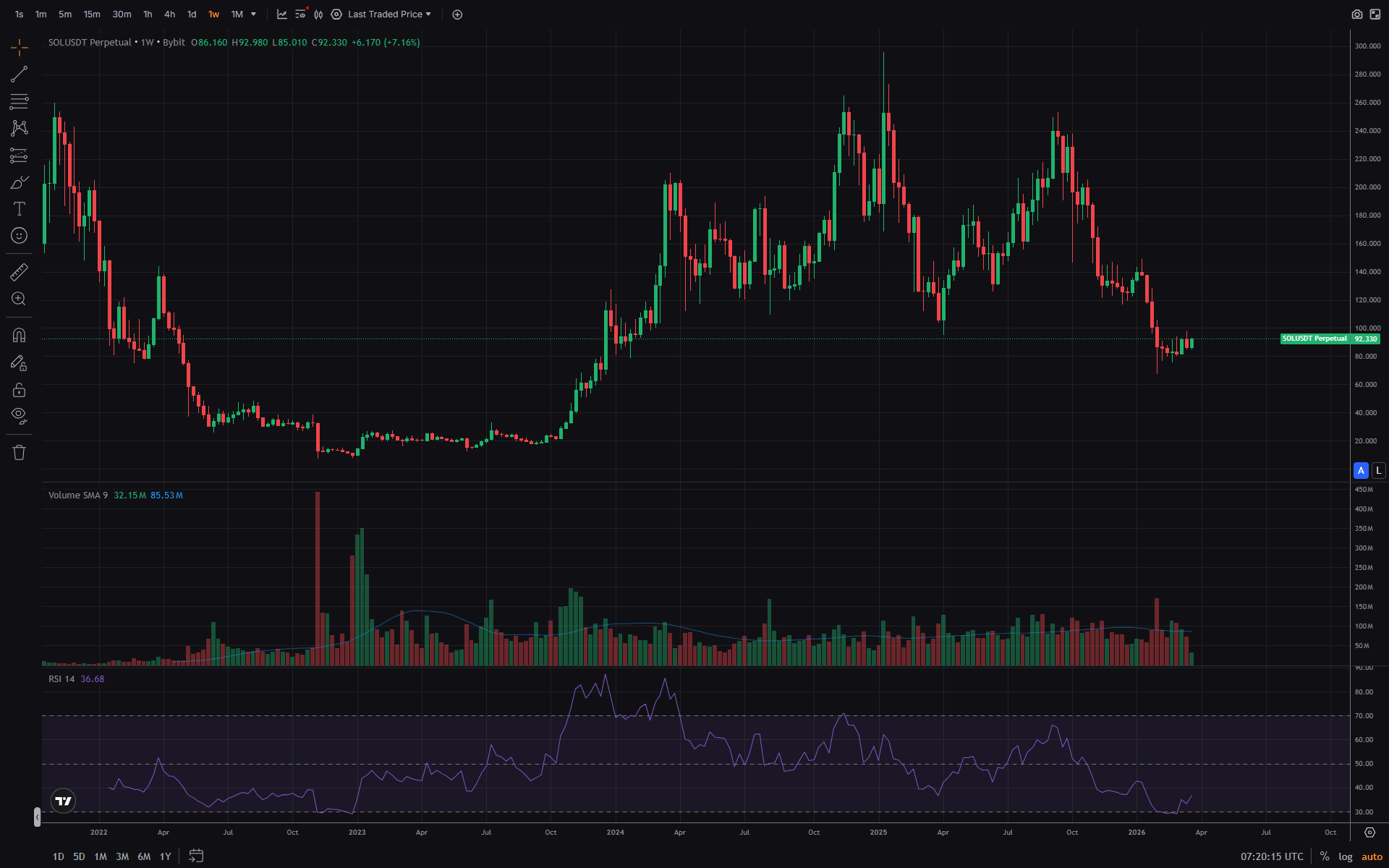
2021: Boom and ATH
2021: Year of Solana growth.
- SOL price: $1.50 (January) → $260 (November)
- Launched: Serum (DEX), Magic Eden (NFT), Marinade (staking)
- TVL: $0 → $10 billion
Problems:
- Network overheating (high demand)
- First outages (November 2021)
2022: FTX and Collapse
November 2022: FTX/Alameda collapse.
Why it hit Solana:
- SBF (Sam Bankman-Fried) was a major Solana investor
- FTX/Alameda held ~$3-5 billion in SOL
- Market panic, mass selling
Result:
- SOL price: $140 → $8 (minus 94%)
- TVL: $10 billion → $200 million
- Recovery took 12+ months
2023-2024: Recovery
2023: Gradual recovery.
- SOL price: $8 → $120
- Launched new projects: Jupiter (aggregator), Tensor (NFT)
- Developers returned (low fees, high speed)
2024: New growth.
- SOL price: $120 → $200+
- Launched: Solana Pay (payments), Saga (smartphone)
- Institutional interest (Visa accepts USDC on Solana)
How Solana Works
Proof-of-History (PoH)
PoH — a time synchronization mechanism in blockchain.
Problem of regular blockchains:
In Bitcoin/Ethereum, validators must “agree” on transaction time. This is slow (10 minutes in BTC, 12 seconds in ETH).
Solana’s solution:
PoH creates cryptographic “clocks” that automatically timestamp every transaction. Validators don’t need to agree — time is already embedded in the data.
Analogy:
- Bitcoin/Ethereum: Each participant checks clocks with others (slow)
- Solana: Everyone has access to atomic clocks (fast)
Proof-of-Stake (PoS)
PoS — a consensus mechanism where validators lock SOL to participate in the network.
How it works:
- Validator locks SOL (collateral)
- Validator verifies transactions and creates blocks
- Validator earns rewards (~7% annually)
- For violations (downtime, malicious behavior) — penalty (slashing)
Requirements:
- Minimum SOL for own node: not required (but need votes)
- Delegation: from 0.01 SOL through pools
Parallel Processing (Sealevel)
Sealevel — technology for parallel smart contract execution.
Ethereum’s problem:
Contracts execute sequentially (one after another). If one contract is slow, everyone waits.
Solana’s solution:
Contracts that don’t conflict execute in parallel. This increases throughput hundreds of times.
Result:
- Theoretical limit: 65,000 TPS
- Real: 2,000-4,000 TPS (still 100-200x faster than Ethereum)
SOL — Solana Token
SOL Tokenomics
Token type: Utility + Governance
SOL functions:
- Fee payment — all transactions are paid in SOL
- Staking — collateral for validators
- Voting — participation in governance (SOL = votes)
- DeFi collateral — security for loans, liquidity
Emission:
- Initial emission: ~489 million SOL (2020)
- Inflation: 8% (first year), -15% annually until reaching 1.5%
- Current inflation: ~5% annually
- Burning: 50% of fees burned
Distribution (at launch):
- 16% — Seed sale (early investors)
- 13% — Founding sale (founders)
- 38% — Validators (rewards)
- 13% — Team
- 10% — Foundation
- 10% — Community & Ecosystem
In circulation:
- ~572 million SOL (March 2026, CoinMarketCap data)
- ~340-350 million SOL staked (~60% of circulating supply)
Comparison: SOL vs ETH
| Parameter | Ethereum (ETH) | Solana (SOL) |
|---|---|---|
| TPS | ~15 | ~2,000-4,000 (real), up to 65,000 (theoretical) |
| Fees | $1-50 | $0.00025 |
| Block time | 12 seconds | 400 milliseconds |
| Consensus | PoS | PoH + PoS |
| Staking | 3-5% annually | 6-8% annually |
| Inflation | ~0.5% (deflation possible) | ~5% (decreasing to 1.5%) |
| Burning | 100% of base fee | 50% of fees |
Solana Staking
What Is Staking
Staking — delegating SOL to a validator to support the network and earn rewards.
How it works:
- Choose a validator (or pool)
- Delegate SOL (any amount)
- Earn rewards (~7% annually)
- Withdrawal: 2-4 days (epoch)
Staking Methods
| Method | Min. Amount | Flexibility | Risk | Yield |
|---|---|---|---|---|
| Own node | Not required (but need votes) | 2-4 days | Low | 7-8% |
| Pools (Marinade, Jito) | 0.01 SOL | Flexible (mSOL, jitoSOL) | Medium | 6-7% |
| Exchanges (Bybit, Binance) | 0.0001 SOL | Depends on exchange | Medium | 5-7% |
Popular solutions:
- Marinade Finance (mSOL): Largest pool, liquid token
- Jito (jitoSOL): Additional MEV rewards
- Bybit/Binance: Simple, but custodial risk
MEV in Solana
MEV (Maximal Extractable Value) — additional validator profit from optimizing transaction order.
Jito — the first protocol to share MEV with stakers.
Yield:
- Base: ~6-7%
- With MEV: ~7-9%
Solana Ecosystem
DeFi (Decentralized Finance)
DeFi on Solana — fast, cheap, convenient.
Categories:
- DEX (decentralized exchanges): Jupiter (aggregator), Raydium, Orca
- Lending: Solend, MarginFi, Kamino
- Staking: Marinade, Jito, Lido (closed)
- Perpetual futures: Drift, Zeta, Jupiter Perps
DEX Comparison on Solana
| DEX | Type | Volume (24h) | Fees | Features |
|---|---|---|---|---|
| Jupiter | Aggregator | $1-3B | 0% | Best route, limit orders |
| Raydium | AMM | $200-500M | 0.25% | Liquidity provision |
| Orca | AMM | $100-300M | 0.30% | Concentrated liquidity |
| Drift | Perps | $50-100M | 0.05-0.10% | Leveraged futures |
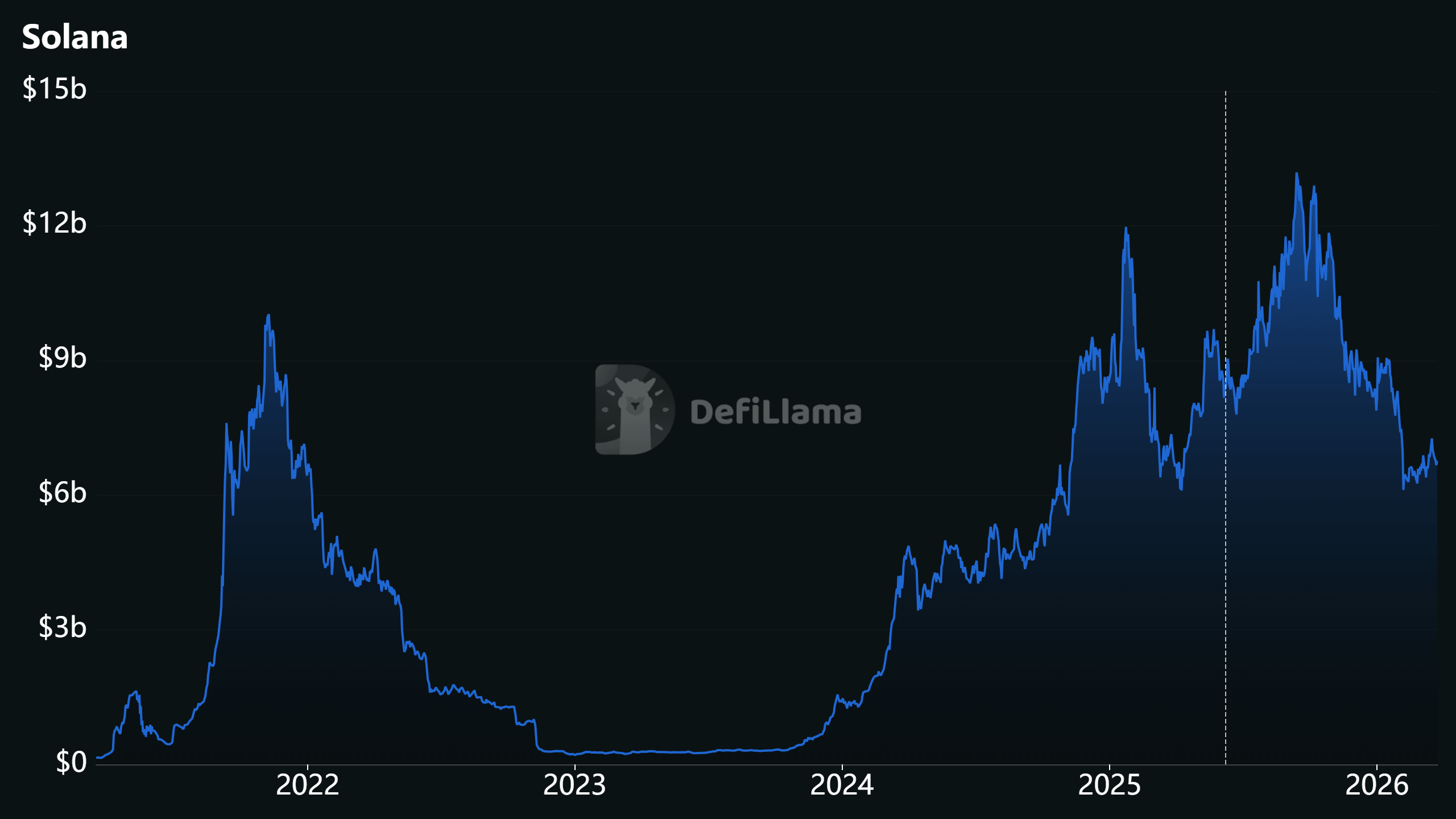
TVL (Total Value Locked): $5-10 billion (fluctuates)
Advantages:
- Fees: $0.00025 per swap
- Speed: ~400 ms per transaction
- UX: like a web app (no need to wait for confirmation)
NFT (Non-Fungible Tokens)
NFT on Solana — an alternative to Ethereum with low fees.
Popular standards:
- Metaplex: Main standard for NFT
- Token Extensions: Extended features (royalties, freezing)
Marketplaces:
- Magic Eden: Largest (multi-chain)
- Tensor: NFT trading (like an exchange)
- Hyperspace: Aggregator
Notable collections:
- Mad Lads, Okay Bears, DeGods (moved to Ethereum), Solana Monkey Business
Games and Social Apps
Games:
- Star Atlas (space strategy)
- Aurory (RPG)
- Genopets (move-to-earn)
Social:
- Dialect (messenger)
- Farcaster (decentralized social network, Solana bridge)
Payments
Solana Pay — protocol for payments in SOL and stablecoins.
Partners:
- Visa (accepts USDC on Solana)
- Shopify (integration for stores)
- Helium (telecom on Solana)
Solana Risks
1. History of Outages
Problem: Solana repeatedly went down (2021-2023).
Reasons:
- Network overload (spam transactions)
- Validator client bugs
- Network attacks
Recent outages:
- September 2021: 17 hours
- September 2022: 7 hours
- February 2023: 18 hours
- December 2023: 5 hours
Solution:
- Validator client improvement
- Rate limiting (spam restriction)
- Fast patch deployment
Status: No outages since January 2024.
2. Competition
Problem: Ethereum Layer 2, Aptos, Sui offer similar advantages.
Solana’s response:
- Firedancer (new validator client from Jump Crypto)
- Increasing throughput to 1 million TPS
- Partnerships (Visa, Shopify, Google Cloud)
3. Regulatory Risks
Problem: SEC may classify SOL as a security.
Status:
- In SEC lawsuit against Binance/Coinbase, SOL mentioned as a security
- Solana Foundation denies, claims SOL is a utility
- Question remains open
4. Dependence on Key Players
Problem: Solana Labs, Alameda Research were major SOL holders.
After FTX collapse:
- Alameda sold/froze most of their SOL
- Foundation continues to fund the ecosystem
- Decentralization growing (less dependence on single player)
How to Buy and Store SOL
Buying SOL
Methods:
- Crypto exchanges: Bybit, Binance, Coinbase (simple, but custodial)
- DEX: Jupiter, Raydium (decentralized, but need SOL for gas)
- P2P: LocalCryptos, Bisq (direct from person)
- Crypto ATMs: BitAccess, CoinFlip (cash → SOL)
Recommendation: For beginners — exchange (Bybit, Binance). For large amounts — P2P or DEX.
Storing SOL
| Type | Examples | Security | Convenience | Fees |
|---|---|---|---|---|
| Hardware wallet | Ledger, Trezor | ⭐⭐⭐⭐⭐ | ⭐⭐⭐ | $50-150 (one-time) |
| Software wallet | Phantom, Solflare | ⭐⭐⭐⭐ | ⭐⭐⭐⭐ | Free |
| Exchange | Bybit, Binance | ⭐⭐ | ⭐⭐⭐⭐⭐ | Free (but withdrawal fees) |
| Paper | Seed phrase printout | ⭐⭐⭐ | ⭐ | Free |
Recommendation:
- Up to $1,000: exchange (simple)
- $1,000-10,000: software wallet (Phantom, Solflare)
- From $10,000: hardware wallet (Ledger Nano X)
Security: Checklist
- Seed phrase: write on paper, store in safe
- 2FA: Google Authenticator (not SMS!)
- Address verification: first and last 4 characters
- Test transaction: before large amount
- Don’t store more than 10% of capital on exchange
- Don’t click links from emails (phishing)
- Don’t give wallet access to third parties
- Don’t connect wallet to suspicious dApps
2026-2030 Forecasts: Possible Scenarios
Ecosystem Development
Expected trends:
- Firedancer will increase network reliability
- Payments (Solana Pay) will go mainstream
- Institutional adoption (Visa, Shopify)
Price Impact: Scenarios
Bull scenario (optimistic):
- TVL reaches $50-100 billion
- Mass payment adoption
- SOL price: $500-1,000
Bear scenario (pessimistic):
- New network outages
- Competition from Ethereum L2, Aptos
- SOL price: $50-100
Important: These are analyst forecasts, not financial advice. Past performance does not guarantee future results.
Summary
Solana — a high-performance blockchain for dApps with low fees and high speed. SOL is used for gas payments, staking, and governance.
Key rules:
- Use liquid staking tokens (mSOL, jitoSOL) for DeFi
- Store SOL in a secure wallet (not on exchange)
- Follow news (Firedancer, regulation)
- Diversify risks (not everything in SOL)
Who Solana is for:
- High-load dApp developers
- DeFi and NFT users (low fees)
- Traders (high speed)
- Stakers (6-8% annually)
Who it’s NOT for:
- Maximum decentralization (BTC, ETH better)
- Don’t trust PoH (new mechanism)
- Want 100% anonymity
FAQ
How much SOL is in circulation?
~572 million SOL (March 2026, CoinMarketCap data). Inflation ~5% annually, decreasing to 1.5%.
Can you mine Solana?
No. Solana uses Proof-of-Stake. Mining is impossible.
What is mSOL?
mSOL — liquid staking token from Marinade Finance. You receive mSOL for locked SOL and can use it in DeFi.
Is it safe to stake SOL on an exchange?
Depends on the exchange. Bybit, Binance — reliable, but custodial risk remains. For large amounts — own node or decentralized pools (Marinade, Jito).
Why did Solana go down?
Network overload, validator client bugs, attacks. No outages since January 2024. Firedancer (new client) should solve the problem.
What is Firedancer?
New validator client from Jump Crypto. Will increase throughput to 1 million TPS and improve reliability. Launch expected in 2026.
How to buy SOL in different regions?
- US/Europe: Coinbase, Binance, Kraken
- CIS region: Bybit, BingX (via P2P)
- Store better on hardware wallet (Ledger) or software (Phantom, Solflare)
Disclaimer
This blog is for informational purposes only. It does not constitute financial or investment advice.
Trading cryptocurrencies and other financial instruments involves high risk. You may lose all your funds.
The author is not responsible for any financial losses resulting from the use of information from this blog.