A timeframe is the time interval that one candle (or bar) represents on the chart. The choice of timeframe affects indicator settings, the number of signals, and the type of strategy: scalping, intraday trading, or swing. This article covers what timeframes are, how they are denoted, how to choose one for your style, and how to align them with RSI, backtests, and strategies.
What Is a Timeframe
Timeframe is the period of time that one candle represents on the chart. One candle on M1 is one minute of price movement, on H4 it is four hours, on D1 it is one trading day. The smaller the timeframe, the more detail and “noise”; the larger, the smoother the picture and the more significant the levels.
The choice of timeframe determines how often you get signals and how long you hold positions. On minute charts there are many trades and positions are held for minutes or hours. On daily and weekly charts there are fewer trades, and positions can be held for days or weeks.
Main Timeframes
Notation is international: a letter and a number.
Minute: M1 (1 minute), M5 (5 minutes), M15 (15 minutes), M30 (30 minutes). Used for scalping and intraday trading. Many signals but a higher share of false ones; discipline and clear exit rules are needed.
Hourly: H1 (1 hour), H4 (4 hours). Suited to medium-term trading within the day or over several days. A balance between opportunities and “noise”. H4 is often used to define trend and key levels.
Daily and above: D1 (day), W1 (week), MN (month). Used for swing and position trading. Signals are rarer but levels and patterns are considered more significant. False breakouts are watched more on H4 and D1 than on M1–M15.
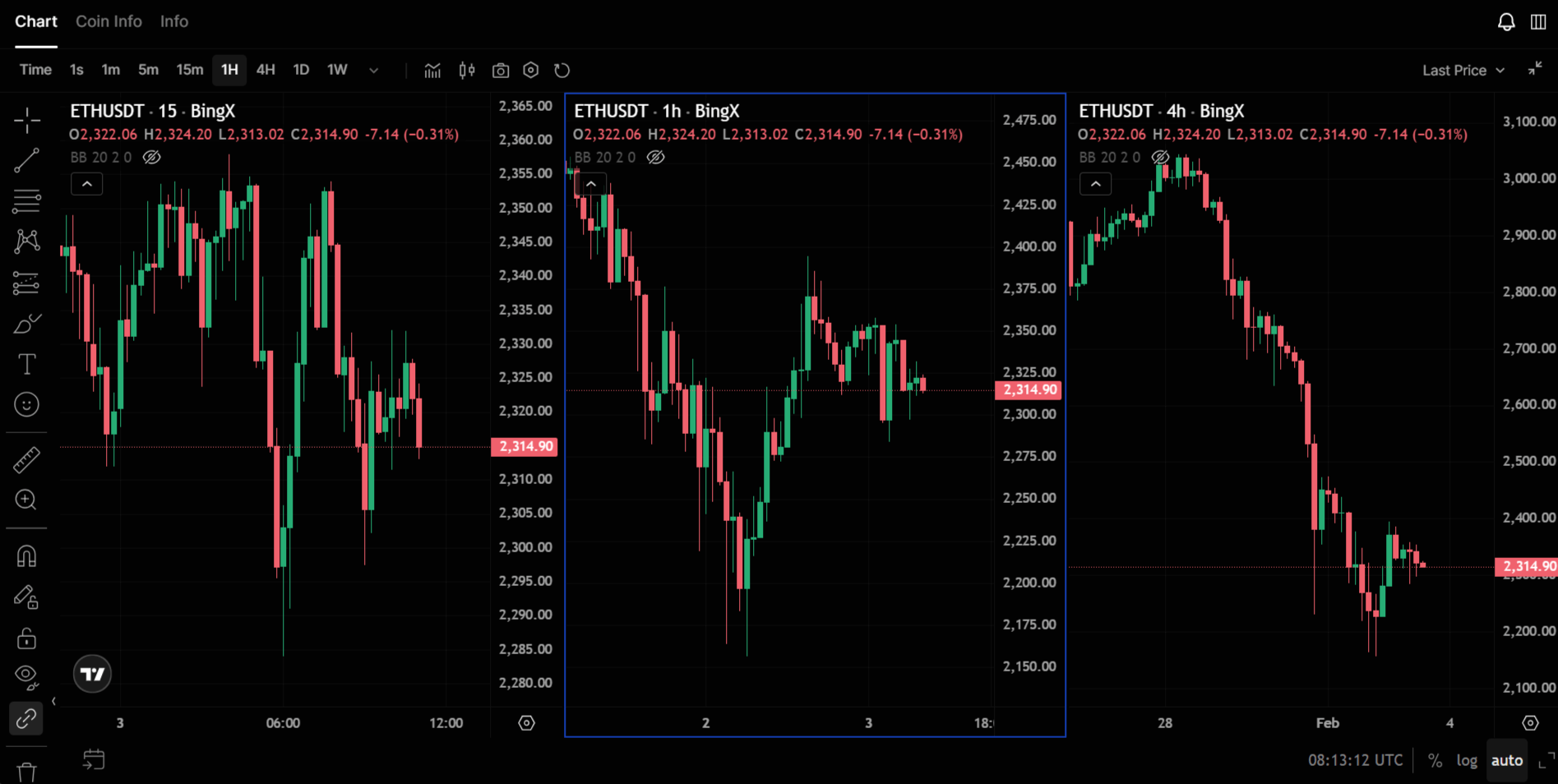
How to Choose a Timeframe for Your Trading Style
Scalping: aim is many small trades per day. Typically M1, M5, less often M15. Fast execution, low fees and spreads matter. Indicators are set to short periods; RSI on M1 gives many signals, some of which are better filtered by a higher timeframe.
Intraday (day) trading: positions are opened and closed within one day. Typical timeframes are M15, M30, H1. Trend and overbought/oversold zones are often viewed on H1 or H4, with entries refined on a lower timeframe.
Swing: positions are held from several days to weeks. H4, D1, sometimes W1. Fewer trades but less noise. Suited to those who cannot watch the chart constantly. Strategies for sideways trend and reversal are often tested on H4 and D1.
Long-term investing and positions: D1, W1, MN. Timeframe for assessing the overall trend and major levels; indicators are set to long periods.
Timeframe and Indicators
The indicator period (e.g. RSI 14 or 20-period moving average) is measured in candles of the chosen timeframe. RSI 14 on M5 is 14 five-minute candles (70 minutes); on D1 it is 14 days. The same period on different timeframes gives different sensitivity: on M1 the indicator reacts faster, on D1 it is slower and smoother.
A common mistake is using too short a period on a higher timeframe or too long on a lower one. Then the indicator either barely moves or produces many false signals. It pays to test settings in backtests for the chosen timeframe and trading style.
Multi-Timeframe Analysis
An approach where trend and zones are defined on a higher timeframe and the entry on a lower one. Example: on H4 identify an uptrend and support zone; on H1 or M15 wait for a bounce and confirmation (e.g. a reversal candle or signal from Williams %R) and only then enter. This reduces entries against the trend and into “noise”.
Timeframes and the Crypto Market
Cryptocurrencies trade around the clock; volume and volatility can change a lot during the day. On low timeframes (M1–M15) this creates many moves but also many false breakout. How to start with a small deposit often advises not to focus on M1 but to start with M15–H1 to combine frequent trades with more readable levels.
Summary
- Timeframe is the interval of one candle (M1, H4, D1, etc.). It drives “noise”, number of signals, and strategy type.
- Lower (M1–M15) for scalping and fast entries; higher (H4, D1) for trend and swing.
- Indicator periods are set in candles of the chosen timeframe; settings are best checked in backtests.
- Multi-timeframe analysis: trend on the higher timeframe, entry on the lower one — helps filter false signals. For automated multi-timeframe strategies, traders often use platforms like Veles — a popular service for running trading bots.
FAQ
What timeframe should a beginner choose?
Start with M15 or H1 — enough signals but less noise than M1–M5.
Can I use multiple timeframes?
Yes, that’s multi-timeframe analysis. Trend on higher (H4/D1), entry on lower (H1/M15).
Why do lower timeframes have more false signals?
Smaller timeframe = more “noise” — random moves. On D1 signals are rarer but more reliable.
How does indicator period depend on timeframe?
Period is measured in candles. RSI 14 on M5 = 14×5=70 minutes, on D1 = 14 days. Different sensitivity.
What timeframe is best for scalping?
M1–M5. But be ready for high trade frequency, commissions, and noise. Many suggest starting with M15.
Disclaimer
This blog is for informational purposes only. It does not constitute financial or investment advice.
Trading cryptocurrencies and other financial instruments involves high risk. You may lose all your funds.
The author is not responsible for any financial losses resulting from the use of information from this blog.