Whitepaper (white paper) is a foundational document when launching new crypto projects. The document contains detailed description of technology, goals, tokenomics and other important aspects of crypto project. Interested investors and users refer to Whitepaper to understand how promising the project is, what problems it solves and what benefits it brings.
What is Whitepaper
Whitepaper is an official document of a cryptocurrency project that contains detailed information about its technical implementation, goals and prospects. Usually Whitepaper includes description of problem the project solves, technical aspects, tokenomics details and development plans. This is the first and most important document to review before investing in cryptocurrency or blockchain startup.
Important: Whitepaper doesn’t guarantee project success. This is a statement of intent, not financial reporting. Always do your own research (DYOR).
Whitepaper vs Roadmap — What to Look For

Although Whitepaper and Roadmap are closely related, they have different functions. Whitepaper is a strategic document containing theoretical foundations of project, while Roadmap is an action plan with development stages and timelines.
Investors should consider both documents: Whitepaper helps assess technical viability and uniqueness of idea, Roadmap — realism of implementation and timeline adherence.
Key differences:
| Parameter | Whitepaper | Roadmap |
|---|---|---|
| Purpose | Description of technology and tokenomics | Development plan by stages |
| Timeframe | Long-term (rarely updated) | Short-term (quarter/year) |
| Audience | Investors, developers, partners | Community, users |
| Content | Problem, solution, architecture, tokenomics | Dates, releases, partnerships |
How Whitepaper is Used in Crypto Projects
At Project Launch Stage
At early stages, Whitepaper plays primary role in building trust to team and project, as well as attracting initial funding.
Attracting investors and funds:
- Main goal of document is to explain what problem project solves and how it does it.
- Important to show competitive advantages and unique technologies.
- Detailed tokenomics helps investors evaluate how tokens are distributed and what their functions are.
- Institutional investors, venture funds and private investors analyze Whitepaper before investing in project.
Conducting ICO/IDO/IEO:
Whitepaper is basis for conducting initial token offering:
- ICO (Initial Coin Offering) — primary token placement for fundraising.
- IDO (Initial DEX Offering) — opening token trading on decentralized exchanges.
- IEO (Initial Exchange Offering) — token placement on centralized exchanges.
Important: After 2026, many ICO/IEO fall under securities regulation. Check token’s legal status in your jurisdiction.
During Project Development and Growth
After successful launch, Whitepaper continues to be used as important document for team, community and partners.
Guide for developers:
- Defines technical architecture of project.
- Helps create smart contracts, as it contains key token parameters.
- Defines consensus algorithm (Proof-of-Work, Proof-of-Stake, etc.).
- Can be used for publication in scientific journals (for example, Bitcoin originally appeared as academic paper by Satoshi Nakamoto).
Roadmap and adaptation:
- Whitepaper often includes Roadmap, but as project develops, document may be updated.
- If project faces new challenges, team may revise technical or economic part.
- For example, Ethereum was originally conceived as PoW blockchain, but later switched to PoS — such changes may be reflected in updated Whitepaper.
Working with regulators:
- In some countries, having quality Whitepaper helps avoid legal problems.
- Document can be used to confirm project legitimacy before regulatory bodies.
- Whitepaper must comply with securities laws if token has investment characteristics.
In Marketing and User Acquisition
This document also plays important role in project promotion.
Community engagement:
- Helps explain to users why they need this token.
- Demonstrates principles of decentralization and community governance.
- Shows mechanisms of staking, farming, voting and other functions attracting users.
Attracting partners and exchanges:
- Whitepaper helps centralized and decentralized exchanges evaluate project before listing.
- Partners use document to assess reliability and long-term viability of project.
What to Look for in Whitepaper When Analyzing Project
1. Problem description:
- Is problem clearly formulated?
- Is it real problem or invented?
- Are there statistics or research confirming problem existence?
Example of good description:
“Existing payment systems charge 3-5% fees for international transfers. Our protocol reduces fees to 0.1% using blockchain technology.”
Example of bad description:
“We will revolutionize finance and become next Bitcoin!”
2. Solution:
- Is solution technically feasible?
- Are there working prototypes or just concept?
- Is blockchain really needed or can it be done with traditional database?
3. Tokenomics:
- What is token’s function in ecosystem?
- How are tokens distributed (team, investors, community)?
- Is there vesting for team and investors?
- What is emission schedule?
Red flags:
- ❌ No max supply specified
- ❌ Team has 30%+ tokens without vesting
- ❌ No clear token utility
- ❌ 50%+ tokens allocated to “marketing” or “advisors”
4. Team:
- Are team members public (names, photos, LinkedIn)?
- Do they have relevant experience?
- Are there advisors with industry reputation?
Red flags:
- ❌ Anonymous team without explanation
- ❌ No links to social media or previous work
- ❌ Fake advisors (check with them on Twitter)
5. Technology:
- Is technical architecture described?
- Is consensus algorithm specified?
- Are there links to GitHub repository?
- Is code audited by third party?
6. Roadmap:
- Are milestones specific and measurable?
- Are timelines realistic?
- Is there progress on previous Roadmap (if project exists)?
7. Legal aspects:
- Is legal entity registered?
- Is jurisdiction specified?
- Are there disclaimers about risks?
- Does token fall under securities regulation?
Red Flags in Whitepaper
❌ Unrealistic promises:
- “Guaranteed 1000% returns”
- “No risk, pure profit”
- “Next Bitcoin”
❌ Plagiarism:
- Copy-paste from other projects
- Check via Copyscape or Grammarly
❌ No technical details:
- Only marketing slogans
- No architecture description
- No links to code
❌ Anonymous team:
- No names, only nicknames
- No links to LinkedIn or previous work
- Stock photos instead of real photos
❌ Tokenomics issues:
- Unlimited emission
- 50%+ to team without vesting
- No clear token utility
❌ No roadmap or vague milestones:
- “Q1 2026: Launch” (no specific date)
- “Q2 2026: Partnerships” (no names)
- No progress updates
How to Verify Whitepaper
Step 1: Check plagiarism
- Use Copyscape, Grammarly or Quetext
- Compare with top-100 projects’ Whitepapers
- Check if technical sections are copied
Step 2: Verify team
- Google each team member
- Check LinkedIn for work history
- Look for publications or conference talks
- Watch out for fake profiles
Step 3: Check code
- Is GitHub repository public?
- Are there recent commits?
- Is code audited (CertiK, OpenZeppelin, Trail of Bits)?
- Are there test coverage reports?
Step 4: Verify partnerships
- Check partners’ websites
- Look for official announcements
- Beware of fake logos (many projects do this)
Step 5: Check legal status
- Is legal entity registered?
- What is jurisdiction?
- Are there terms of service and privacy policy?
- Does token have security characteristics?
Examples of Good Whitepapers
Bitcoin (2008):
- 9 pages, clear and concise
- Describes problem (double-spending) and solution (PoW)
- No marketing, only technical details
- Available at: bitcoin.org/bitcoin.pdf
Ethereum (2014):
- Describes smart contracts concept
- Technical architecture with EVM
- Clear use cases and examples
- Available at: ethereum.org/whitepaper
Chainlink (2017):
- Describes oracle problem
- Technical solution with decentralized network
- Detailed tokenomics with incentives
- Available at: chain.link/whitepaper
Summary
Whitepaper is foundational document of crypto project. It helps investors assess technical viability, tokenomics and team. Always read Whitepaper before investing, but don’t rely solely on it — do your own research.
Key takeaways:
- Whitepaper describes problem, solution, tokenomics, team
- Roadmap shows development timeline
- Check for red flags (plagiarism, anonymous team, unrealistic promises)
- Verify team, code, partnerships, legal status
- Whitepaper doesn’t guarantee success — DYOR
More on tokenomics: What is Tokenomics.
FAQ
What is whitepaper in crypto?
Official document describing project’s technology, tokenomics, team and plans. Used to attract investors and explain project’s value proposition.
Is whitepaper legally binding?
No. Whitepaper is statement of intent, not contract. However, if token is classified as security, whitepaper may fall under securities regulation.
How to check if whitepaper is plagiarized?
Use Copyscape, Grammarly or Quetext. Compare with top-100 projects’ whitepapers. Check if technical sections are copied word-for-word.
What are red flags in whitepaper?
- Anonymous team without explanation
- No technical details, only marketing
- Unrealistic promises (“1000% guaranteed”)
- No max supply or unlimited emission
- 50%+ tokens to team without vesting
- No roadmap or vague milestones
Should I invest based only on whitepaper?
No. Whitepaper is starting point, not sole basis for investment. Also check: team background, code audits, community activity, tokenomics, competitors, market conditions.
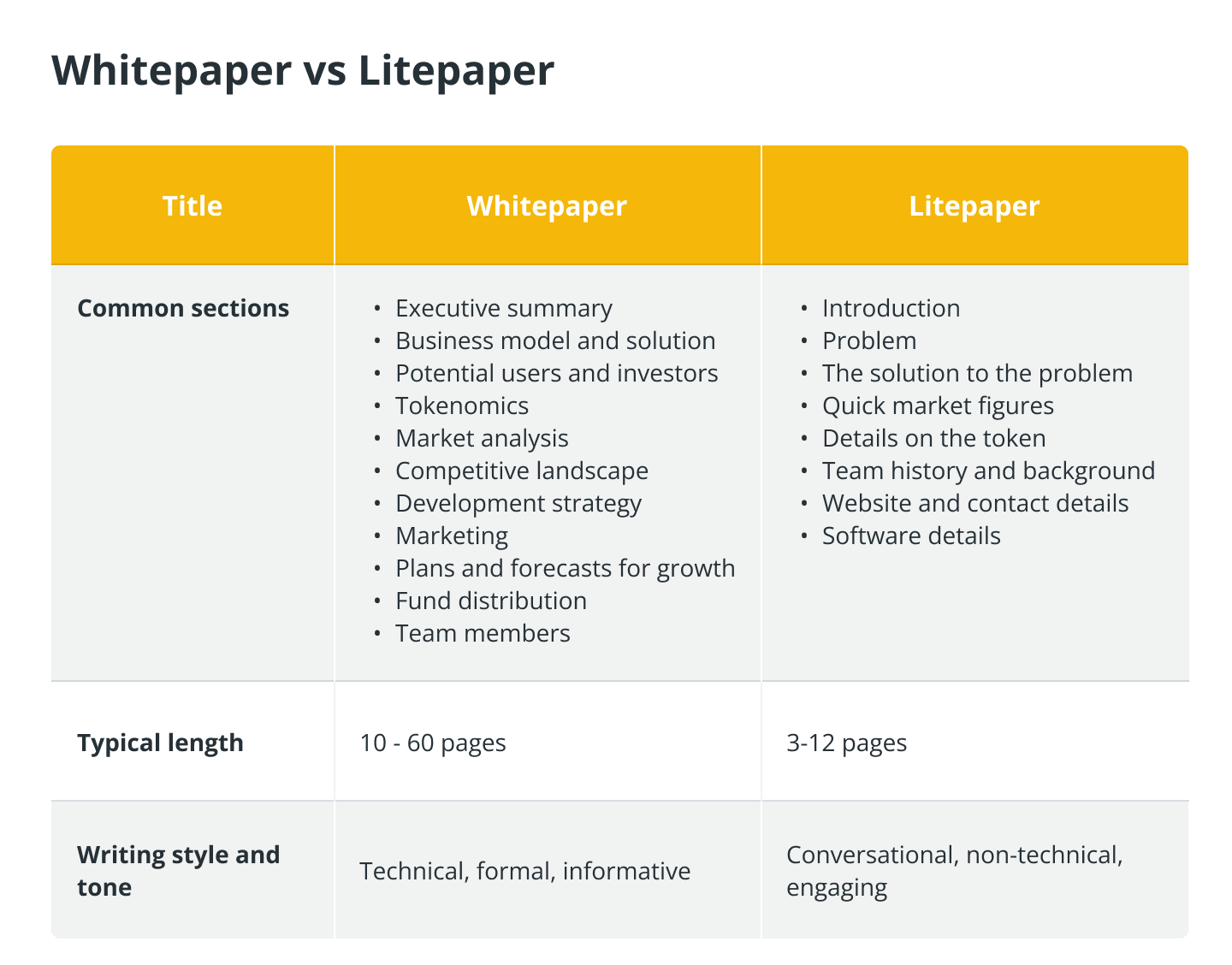
What is difference between whitepaper and litepaper?
Whitepaper is full technical document (50-100+ pages). Litepaper is shortened version (5-20 pages) with key points for quick reading.
Where to find project’s whitepaper?
- Project’s official website (usually in footer)
- GitHub repository
- CoinMarketCap or CoinGecko project page
- Medium or project’s blog
How often is whitepaper updated?
Rarely. Whitepaper is long-term document. Roadmap is updated more frequently (quarterly). If project changes significantly, team may release Whitepaper v2.0.
Can whitepaper guarantee project success?
No. Whitepaper is plan, not guarantee. Many projects with excellent whitepapers failed due to poor execution, competition, or market conditions. Always do your own research.
What if whitepaper is in foreign language?
Use Google Translate or DeepL. Quality projects usually have English version. If only Chinese/Russian/Korean — may be regional project, check if it’s available in your jurisdiction.
Disclaimer
This blog is for informational purposes only. It does not constitute financial or investment advice.
Trading cryptocurrencies and other financial instruments involves high risk. You may lose all your funds.
The author is not responsible for any financial losses resulting from the use of information from this blog.