ELDER 2.0 spot strategy is an automated trading system on the spot market with position averaging, based on three key indicators. The strategy has proven its effectiveness over years of practical use in algorithmic trading.
Why ELDER 2.0?
This strategy was developed for working on the spot market, where there is no liquidation risk. The key idea is to enter a position in small parts when overbought/oversold signals appear and average down on pullbacks.
Advantages of the approach:
- Trading without leverage — no liquidation risk
- Position averaging instead of stop-losses
- Automation via exchange trading bots
- Proven effectiveness in various market conditions
Three Pillars of the ELDER 2.0 Strategy
1. Stochastic Oscillator — the main signal
Function: Identifying overbought and oversold zones for entry points. Read more about how the Stochastic indicator works in a separate article.
Settings: 14, 3, 3. Oversold zone: 20, Overbought zone: 80.
2. Bollinger Bands — volatility filter
Function: Signal confirmation during price stretches. Learn more about Bollinger Bands and their application.
Settings: Period 20, Deviation 2.0.
3. CMO (Chande Momentum Oscillator) — momentum filter
Function: Filtering out false signals. A detailed breakdown of the CMO indicator will help to better understand its role.
Settings: Period 14, Filtration zone: from −50 to +50.
Strategy Algorithm
Entry signal (opening/averaging)
Enter a trade when the following conditions are met simultaneously:
- Stochastic < 20
- Price touches or is below the lower Bollinger Band
- CMO < −50
Exit signal (profit-taking)
Close the position when:
- Stochastic > 80
- Price touches or is above the upper Bollinger Band
- CMO > +50
- Profit from the average entry price is ≥ 3–5%
Capital Management
Deposit distribution
- Base order: 5% of the deposit
- Safety orders: from 5% to 15% depending on the drawdown depth
- Maximum number of safety orders: 4–6 orders
- Reserve: 20–30% of the deposit
Averaging steps
Recommended intervals:
- 1st averaging: −5% from entry
- 2nd averaging: −10%
- 3rd averaging: −15%
- 4th averaging: −20%
Recommended Timeframes and Assets
| Timeframe | Description | Risk |
|---|---|---|
| 4H (4 hours) | Optimal for beginners. Less noise, more stable signals. | Low |
| 1H (1 hour) | Balance between signal frequency and quality. | Medium |
| 30 minutes | More trades, but more false signals. | High |
| 5-15 minutes | Scalping. Only for experienced traders. | Very high |
Recommendation: Start with 4H, test for 1-2 months, then move to smaller timeframes.
Assets:
- Required: BTC, ETH (liquidity, low spread)
- Recommended: TOP-20 by market cap (SOL, BNB, XRP, ADA, etc.)
- Avoid: Coins with volume < $1M/day
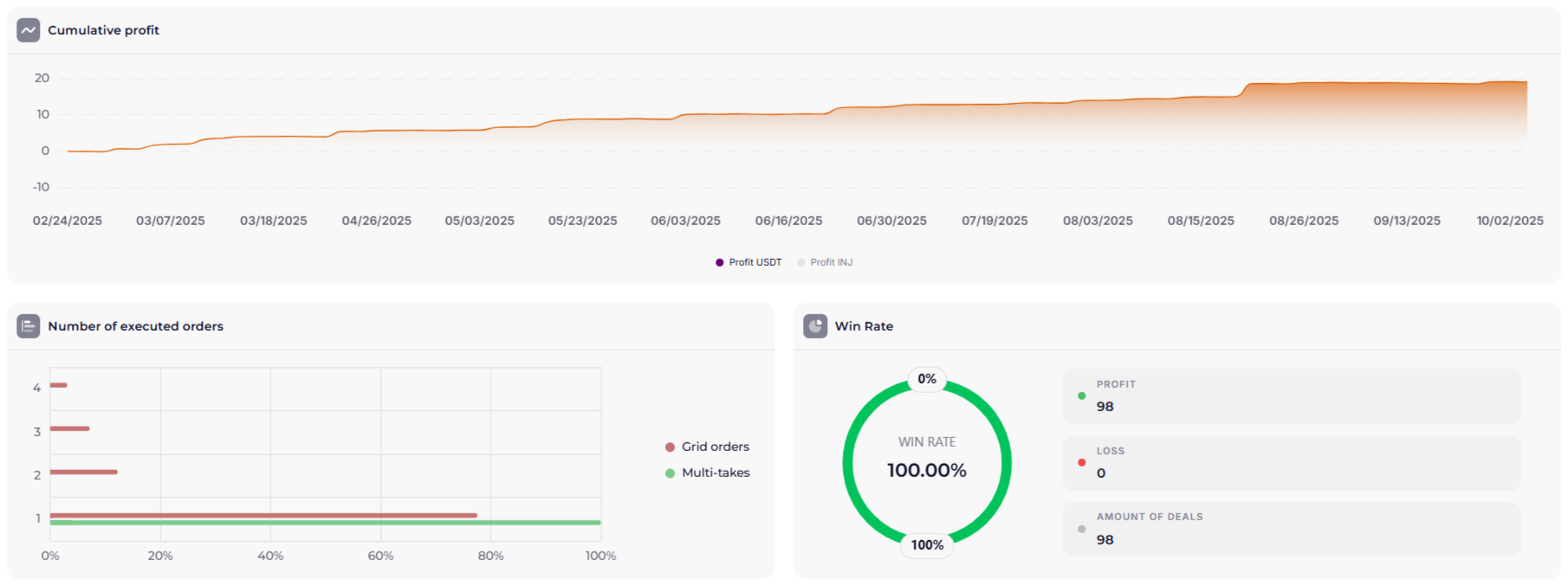
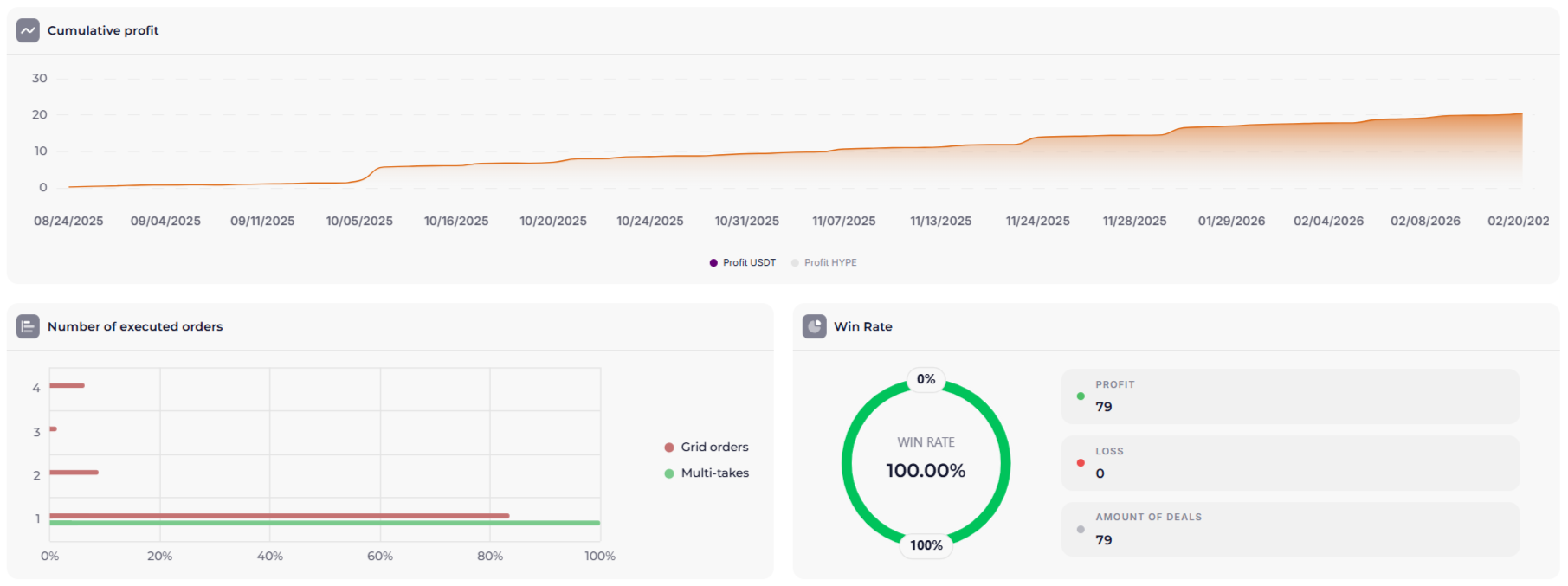
Backtests ELDER 2.0
Summary
The ELDER 2.0 spot strategy is a fundamental approach to working in the crypto market without liquidation risk. Key advantages: position averaging instead of stop-losses, three-factor signal filtering, and automation through bots. The strategy has proven stable in various market conditions.
FAQ
Why spot and not futures?
On spot, there’s no liquidation risk — the position can drop indefinitely but won’t be liquidated. This is ideal for long-term investing with averaging.
How much money do I need to start?
Minimum $100-200 recommended. With $100 deposit, base order 5% = $5. This is enough for 4-6 averaging orders.
Which timeframe should beginners choose?
Start with 4H (4 hours) — less noise than 1H. After testing, you can switch to 1H for more frequent trades.
What if all 6 averaging orders are used and price is still lower?
If reserves are exhausted, it’s better to take the loss and start fresh with a different coin. Don’t increase position beyond the plan — this leads to margin call.
Does ELDER 2.0 work on low-liquidity coins?
No. Use only TOP-20 by market cap (BTC, ETH, SOL, BNB, etc.). Low-liquidity coins can give false signals and order execution issues.
Do I need to change indicator settings for different coins?
Base settings (14,3,3 for Stochastic; 20,2.0 for Bollinger; 14 for CMO) work universally. Experienced traders may adjust periods based on asset volatility.
Disclaimer
This blog is for informational purposes only. It does not constitute financial or investment advice.
Trading cryptocurrencies and other financial instruments involves high risk. You may lose all your funds.
The author is not responsible for any financial losses resulting from the use of information from this blog.