⚠️ Disclaimer: This review and configurations are not investment advice or a guide to action. Cryptocurrency trading involves the risk of capital loss. Always refer to the official platform documentation: Ginarea Documentation.
Ginarea — a platform for creating trading bots with a visual strategy constructor. This article shares our hands-on experience with the platform and specific Dynamic bot configurations. For a general overview of the platform, check out the Ginarea platform overview, and for algo trading basics — the trading bots guide. Metrics for asset evaluation, mentioned in the context of coin selection, are covered in the introduction to fundamental analysis.
Our Journey with the Platform
We first encountered Ginarea a few years ago, but returned to it more seriously in 2026. The test deposit was modest — around $300 on a Bybit sub-account (after a liquidation on one of the accounts). Later, as we scaled up the direction, we added another ~$100.
Testing on BitMEX ran on an even smaller deposit — $50–60.
To refresh our skills and ease into trading on each exchange, we started with the minimum number of assets and the minimum order size. Only after calibrating the settings did we add new assets, closely monitoring the initial margin level.
Starting Asset Set
This is not a general recommendation — just what we started with ourselves. Before launching a bot on any asset, it’s advisable to study its characteristics and review at least a year of price chart data.
Bybit
| Asset | Notes |
|---|---|
| CRO/USDT | Base asset for calibration |
| CRV/USDT | Volatile, shows grid bot mechanics well |
| HBAR/USDT | Stable, predictable behavior |
| 1000PEPE/USDT | Caused the most trouble — memecoin with sharp swings |
| TIA/USDT | In a slight drawdown at the time of writing |
| UMA/USDT | Least expected performance, went into drawdown — likely due to initial calibration. Chart evened out later |
| SOL/USDT | Added as one of the last, when we shared market updates |
BitMEX
| Asset | Notes |
|---|---|
| ADA/USDT | Calm asset, good for learning |
| SUI/USDT | Promising L1, interesting dynamics |
| XRP/USDT | Classic, predictable behavior |
| SOL/USDT | Same as the Bybit account |
| LTC/USDT | Interesting to study behavior specifically in 2026 |
| ETH/USDT | Favorite of the BitMEX asset pool. Thanks to more stable and balanced metrics, the profit chart is smoother — at the time of writing, the ETH configuration has already locked in decent profit over 5 times |
Bot types, mechanics, and configuration details are thoroughly described in the official Ginarea documentation — we recommend studying it before launching. Below is our experience and observations on Dynamic, which is currently running.
P&L Trailing: A Critical Setting
We strongly recommend carefully reviewing the P&L trailing settings in the official docs first.
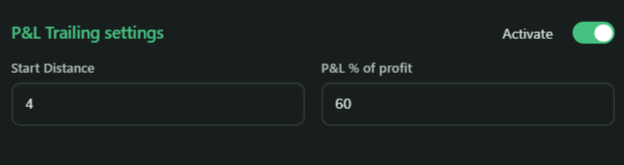
Our configuration for the current market:
- Distance: 4%
- Trailing %: 60%
This means that when the price moves more than 4% away — 60% of the profit from closed orders within the position is used to cover hanging orders outside the range.
Not a silver bullet, but this flexible approach lets you control an open position quickly and conveniently. In critical moments we switched to 1%/90% — it bailed us out of deep drawdown a couple of times.
Current Configuration
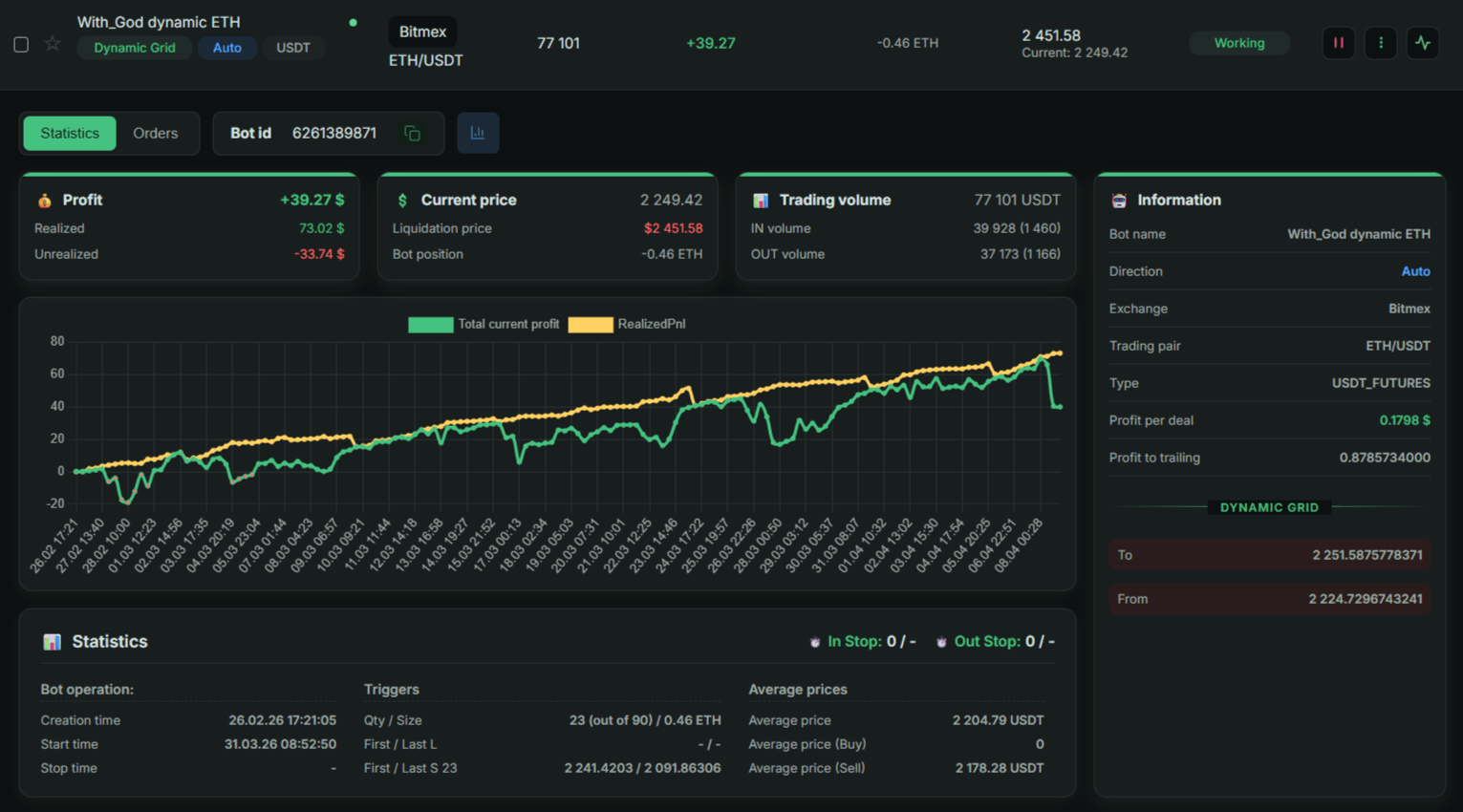
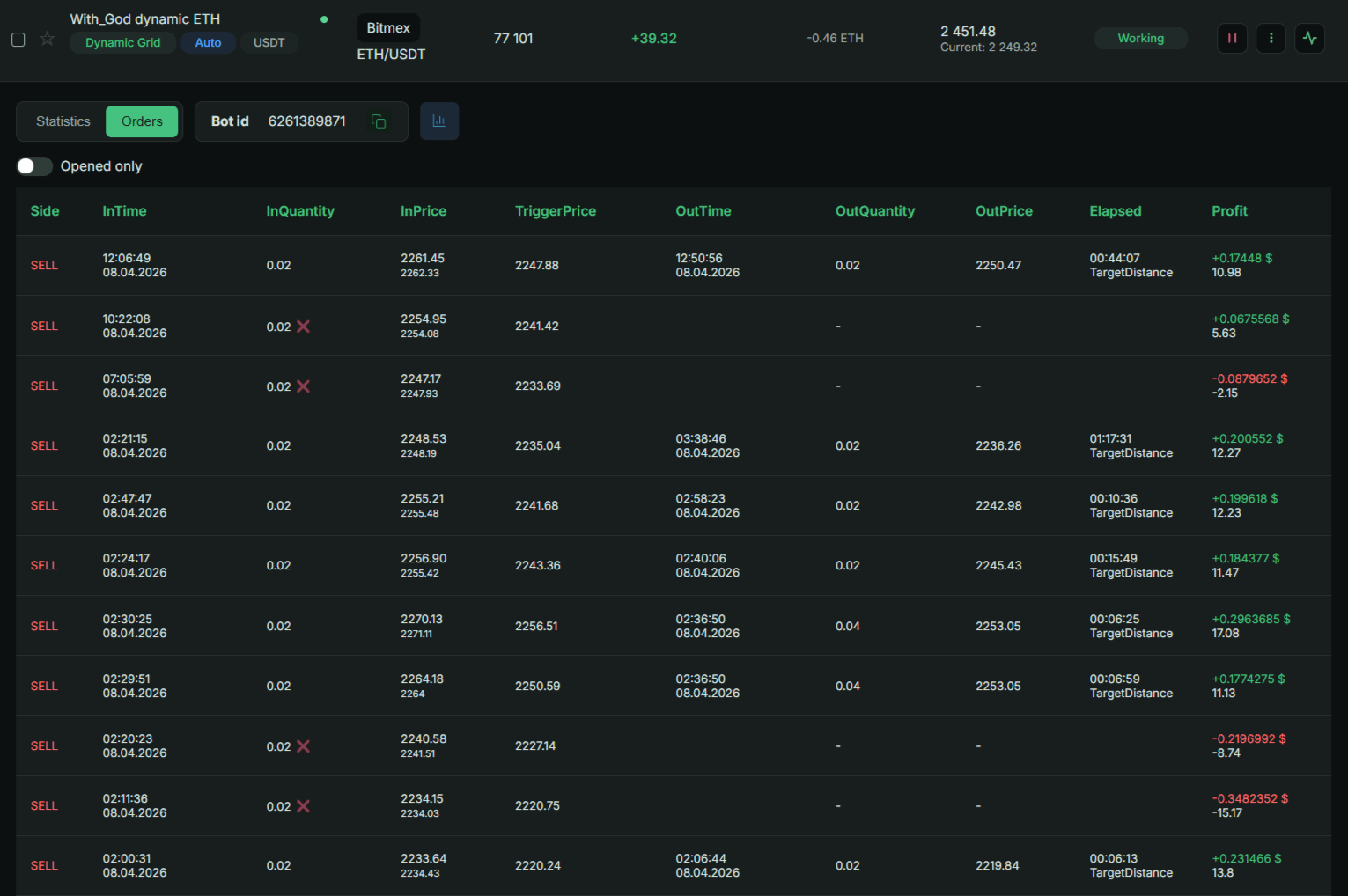
One of the configurations currently running on one of the accounts (stats are available in our open trading journal):
- With_God dynamic ADA (red. 17.04)
💡 Tip: Study other people’s public bot settings — it’s a great way to understand the logic and find ideas for your own bots.
Key Observation
If you start trading 10 assets simultaneously — margin gets spread too thin. Better to start with 1–3 assets, then gradually add more.
Takeaways
Here’s what we learned from working with Ginarea:
- Start small. Minimum deposit, 1–2 assets, minimum orders. Only scale up after you understand how the bot behaves.
- P&L trailing saves you. The 4%/60% config works well in the current market, and 1%/90% has already bailed us out in critical moments.
- Watch your margin. Each new asset adds load to the initial margin. Add them gradually.
- Docs are your foundation. Ginarea keeps updating, and the official instructions have details that aren’t obvious at first glance.
- Analytics matter. Check bot stats regularly — launched doesn’t mean forgotten. Drawdown, number of trades, average profit per trade — all of this helps you adjust settings in time.
Further reading: Trading Bots for Beginners — a complete guide to bot types and strategies.
Disclaimer
This blog is for informational purposes only. It does not constitute financial or investment advice.
Trading cryptocurrencies and other financial instruments involves high risk. You may lose all your funds.
The author is not responsible for any financial losses resulting from the use of information from this blog.